
Strategy · Europe · Supply chains
Mexico–EU trade in 2026: the opportunity begins before entry into force
The modernized agreement has been signed and the European Union has completed its internal process. It is not yet in force. This interval is the right time to validate origin, compliance, routing and landed cost—before opportunity becomes execution pressure.
Palos Garza Guadalajara · July 28, 2026 · 11-minute read
Status as of July 28, 2026
Mexico and the EU signed the Modernised Global Agreement and Interim Trade Agreement on May 22. The EU Council completed its internal process on July 14. Mexico must still complete its process and both parties must exchange notifications. The interim agreement will enter into force on the first day of the second month after that exchange; until then, the framework in force since 2000 continues to apply.
The scale of the relationship warrants preparation: bilateral trade in goods reached nearly €87 billion in 2025, while trade in services exceeded €29 billion in 2024. The EU is Mexico's third-largest trading partner, and Mexico is the EU's second-largest trading partner in Latin America.
The interim agreement modernizes the trade pillar by eliminating most remaining customs duties, expanding access in services, investment and public procurement, and strengthening customs, trade facilitation, digital trade, intellectual property and critical-raw-material provisions. A signature, however, does not reduce landed cost on its own. Value appears when a company converts the new rule into a qualifying, documented and repeatable operation.
The question is not simply “Will the tariff fall?”
The stronger question is: “Will our product qualify, can we prove it, and will the savings exceed the cost of compliance and execution?” A preference can be lost through incorrect tariff classification, an origin rule the product does not satisfy, incomplete records, sanitary or technical restrictions, or a route that consumes the savings through inventory and variability.
What the agreement may enable
- lower duties for qualifying goods;
- simpler procedures and standards for smaller firms;
- broader access to services and public procurement;
- new opportunities in food, raw materials and digital trade.
What the company must still solve
- tariff classification and applicable origin rule;
- evidence for materials and production processes;
- import-country regulation, registration and labeling;
- Incoterm, gateway, frequency, inventory and landed cost.
Six decisions worth making before entry into force
- Segment the portfolio by real potential. Not every SKU deserves equal effort. Prioritize volume, current tariff, margin, expected growth and ability to prove origin.
- Model origin from the bill of materials. Purchasing, engineering and trade compliance should identify non-originating materials, critical processing and evidence required from suppliers.
- Build landed cost by corridor. Compare more than freight: origin handling, gateway, clearance, storage, demurrage, inventory, insurance, distribution and contingency.
- Design destination compliance. CE marking, REACH, CLP, sanitary rules, labeling, traceability or registrations may matter more than the tariff, depending on the product.
- Assign commercial responsibility. The Incoterm should match the organization's actual ability to manage export, import, insurance, taxes and final delivery.
- Prepare an alternate route. A resilient chain defines what changes when congestion, blank sailings, inspections, equipment shortages or demand shifts occur.
Gateway design: the right port depends on product and destination
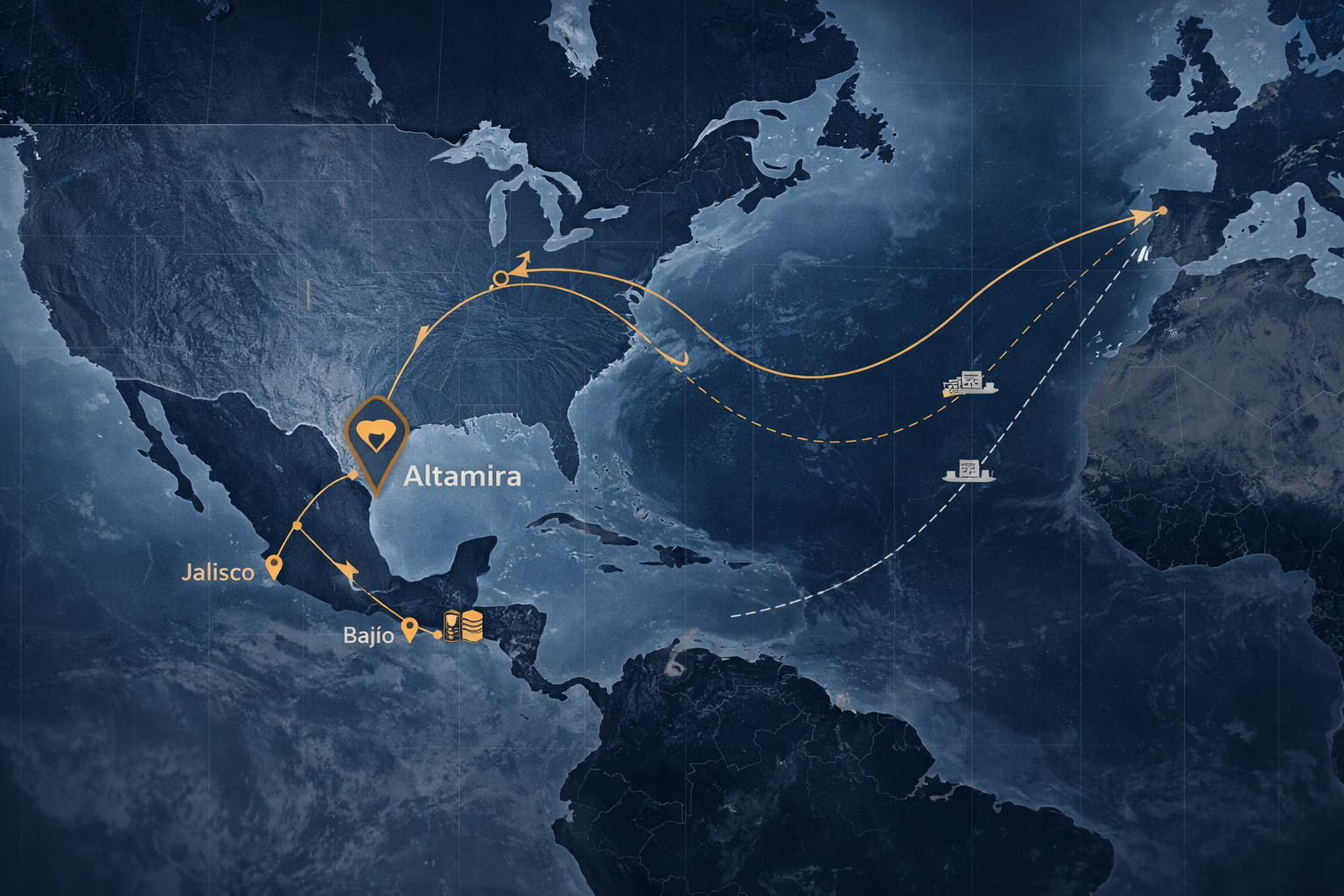
For direct ocean trade with Europe, Veracruz and Altamira are natural Gulf gateways serving central Mexico, the Bajío and the northeast. Selection should not rely on distance alone. Sailing frequency, carrier, European port, equipment availability, receiving window, cargo type and demurrage exposure can reverse the result.
For Jalisco and Western Mexico, the analysis should compare inland transport to the Gulf with intermodal or service-specific alternatives. Air from Guadalajara, Mexico City or Monterrey can fit high-value goods, samples, spares and genuine urgency, but it should be a designed exception rather than a recurring rescue. Some European freight enters through the United States and crosses at Laredo; the option can work, but adds transit, origin, documentation and border-coordination variables.
| Decision | Variables to compare |
|---|---|
| Veracruz vs. Altamira | inland origin/destination, frequency, EU port, equipment and variability. |
| Ocean vs. air | value per kilogram, urgency, downtime cost, shelf life and inventory. |
| Direct vs. via U.S. | transit, double handling, customs requirements, border crossing and landed cost. |
| FCL vs. LCL | volume, consolidation, damage exposure, free time and required frequency. |
High-potential industries—and their main condition
Automotive, auto parts and mobility
Mexico and Europe share manufacturing programs and Tier 1/Tier 2 networks. Components, machinery and spares present opportunity; the condition is proving origin across complex bills of materials and maintaining sequenced delivery without making expedited air the default.
Machinery, automation and green technology
Production equipment, automation, clean energy and critical components can benefit from investment and diversification. Dimensions, handling, installation, spares, warranties and the separation of goods and services must be planned early.
Aerospace, electronics and precision devices
High value, low weight and time sensitivity support hybrid ocean-air networks. Opportunity depends on lot or serial traceability, export controls where applicable, specialized packing and suppliers able to document origin.
Pharmaceuticals and medical devices
Growth may center on ingredients, equipment and high-value finished goods. Regulatory release, temperature, security, expiration and continuity usually outweigh a small freight-rate difference.
Agri-food and beverages
Tequila, berries, processed foods and Mexican specialties may find more space, while European products gain access to Mexico. Sanitary requirements, cold chain, labeling, shelf life and geographical indications must be solved before routing.
Chemicals, plastics and critical materials
The industry can benefit from diversified supply, but container compatibility, hazardous-material classification and EU REACH/CLP compliance are decisive. Technical data should enter logistics design before space is booked.
A practical 30-day exercise
Early preparation turns the agreement into a real option
Palos Garza can support Mexico–Europe corridor design, Mexican customs coordination, transportation, warehousing, inspections and route operating assessments. The goal is not to anticipate a preference that is not yet in force, but to build the system capable of capturing it when all conditions are met.
Evaluating a European route, supplier or market?
Share product, origin, destination, frequency, volume, Incoterm and primary constraint. We can build a comparable operating scenario or participate in your next supplier onboarding, RFQ, RFP or BID.
Official sources
- Council of the EU: final approval and next steps for the Interim Trade Agreement
- European Commission: EU–Mexico agreement and status
- Mexico Ministry of Economy: approval of the Modernised Global Agreement
- European Commission: trade figures and general benefits
Information updated July 28, 2026. Entry into force and applicable rules must be confirmed before making tariff, regulatory or contractual decisions.