
Confitexpo 2026 · Food · International trade
From innovation to the shelf: the logistics decisions behind Mexico's confectionery industry
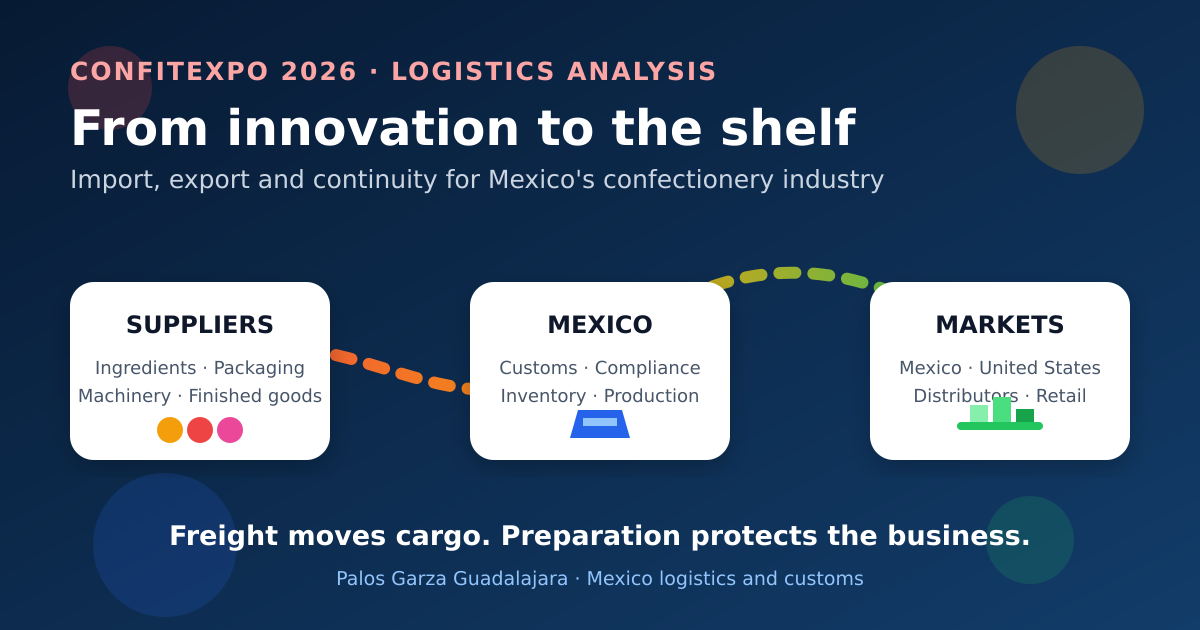
Confitexpo brings together products, ingredients, packaging, machinery, manufacturers and buyers. That diversity points to one conclusion: the commercial opportunity does not end with a strong product; compliance, routing and inventory must allow it to reach the market without disruption.
By Marcos Márquez · Palos Garza Guadalajara · August 11, 2026 · 9-minute read
The operating thesis
In confectionery, an operation can lose viability before the container is loaded. An incorrect classification, incomplete label, unverified ingredient or poorly calculated commercial window can turn sellable inventory into detained inventory.
The 2026 edition of Confitexpo demonstrated the reach of a value chain connecting manufacturers of candy, chocolate, gummies, cookies and snacks with suppliers of flavors, colors, raw materials, packaging, machinery and major commercial channels. From a logistics standpoint, the value of the event lies not only in seeing new products, but in understanding what must happen for each innovation to reach the right market.
Mexico operates in both directions. It imports ingredients, additives, equipment, packaging materials and finished goods; it also exports brands, manufacturing capacity and formulations to the United States and other destinations. Each flow requires different decisions, but both share a principle: commercial, sanitary, customs and logistics records must align before a delivery date is promised.
Importing into Mexico: the product begins long before the shelf
For an importer, confirming price and availability is not enough. Tariff classification and composition determine duties, regulations and documents. A product's treatment may change because of its sugar, cocoa, milk, gelatin, fruit, alcohol, sweetener or other content. Its intended use also matters: retail sale, industrial processing or commercial sample.
Prepackaged food sold in Mexico must be reviewed against applicable commercial and sanitary information requirements, including NOM-051 when relevant. Label information, ingredients, allergens, nutrition declarations, warning seals and responsible-party details should not be corrected after the freight has reached a port or border.
Ingredients, additives and raw materials
These require supplier traceability, specifications, lot data, shelf life and confirmation of intended use. Commercial risk increases when purchasing, quality and trade compliance use different versions of the formula.
Machinery, molds and packaging lines
Beyond classification and valuation, dimensions, handling, installation, spare parts and startup dates must be coordinated. A detained machine can affect an entire production season.
Finished goods
Label, packaging, shelf life and sales channel must be resolved before shipment. A technically correct import still fails commercially if the selling window has already closed.
Packaging and promotional materials
A delay can stop production even when every ingredient is available. Packaging belongs in the production plan; it is not a secondary input.
Exporting from Mexico: U.S. entry requires importer and manufacturer readiness
Food shipments entering the United States may require, as applicable, registration of facilities that manufacture, process, pack or hold food, prior notice, compliant labeling and importer controls under the Foreign Supplier Verification Program. FSVP compliance does not replace prior notice; they are separate requirements.
The conversation must begin before transportation is quoted. The manufacturer, U.S. importer, customs broker, carrier and food-safety teams need to know who owns each requirement. When responsibility remains implicit, the first shipment becomes an improvised audit at the border.
| Decision | Question to resolve | Consequence of omission |
|---|---|---|
| Product | Are ingredients, formulation and labeling admissible at destination? | Detention, relabeling or refusal. |
| Ownership | Who is the importer, FSVP importer and owner of each record? | Incomplete files and late decisions. |
| Route | Does the port or border protect delivery date and shelf life? | Expedites, added cost and missed windows. |
| Condition | Are temperature, humidity, loading and cleanliness defined? | Damage, deformation, contamination or loss. |
| Contingency | What happens during inspection, delay or document refusal? | An exception becomes a crisis. |
Logistics cost is more than freight
In confectionery, total cost includes immobilized inventory, delays, storage, handling, relabeling, expedited transportation, missed seasons and product deterioration. The lowest freight rate can become the most expensive option when it fails to protect the commercial date.
This is especially relevant for temperature-sensitive chocolate, short-shelf-life products, seasonal campaigns, launches, private-label programs and goods dependent on promotional packaging. The route should be designed around the consequence of failure, not only the average transit time.
An operating scenario: the launch that arrives after its window
Consider a Mexican company preparing a product for a U.S. retailer. The buyer confirms a delivery date, production reserves capacity and transportation receives an urgent request. Yet the FSVP importer, final label review and supplier evidence remain unresolved. The truck may be ready, but the operation is not.
The answer is not to promise an extraordinary crossing. It is to move preparation upstream: records and ownership before production; classification and label before printing; route and contingency before selling; appointment and inventory before loading. Sustainable speed is built through repeatability.
Four profiles with an immediate opportunity
Mexican manufacturers preparing to export. Before adding capacity or committing to an international buyer, they need to validate the product, records, labeling, importing counterpart and route. A well-documented pilot can become the foundation of a recurring program.
Importers and distributors in Mexico. Their risk extends beyond customs clearance. Regulation, Spanish-language information, shelf life, inventory and commercial availability must be coordinated before the foreign supplier confirms departure.
Private-label programs and retailers. When manufacturer, brand, packaging and channel belong to different companies, document ownership can fragment. A responsibility and deadline matrix prevents logistics from discovering late decisions that belonged in product development.
Suppliers of ingredients, packaging and machinery. Their opportunity expands when the sale includes clear specifications, records and logistics conditions. The ability to import the input or install the equipment is also part of the supplier's value proposition.
Checklist before the next shipment
- Confirm composition, use, presentation and tariff classification.
- Identify regulations and restrictions by product, origin and destination.
- Validate label, ingredients, allergens, lot and shelf life before printing or shipping.
- Define Incoterm, importer, food-safety responsibilities and owner of each document.
- Select route and transportation mode according to commercial date and cargo condition.
- Design a protocol for inspection, delay, temperature excursion or document discrepancy.
- Run a pilot shipment before committing volume or a seasonal program.
Where Palos Garza can support
Palos Garza integrates customs brokerage, transportation, warehousing, inspections and operational presence at ports and borders. For confectionery manufacturers, importers and exporters, the objective is to connect the record with execution and reduce handoff points between providers.
We can review an upcoming shipment, evaluate a corridor or participate in a BID to compare scope, controls, contingencies and total cost without disrupting an operation that already works.
Discuss an operationNote: Requirements depend on tariff classification, composition, origin, destination, presentation and intended use. This article is informational and does not replace a product-specific customs, sanitary or legal review.